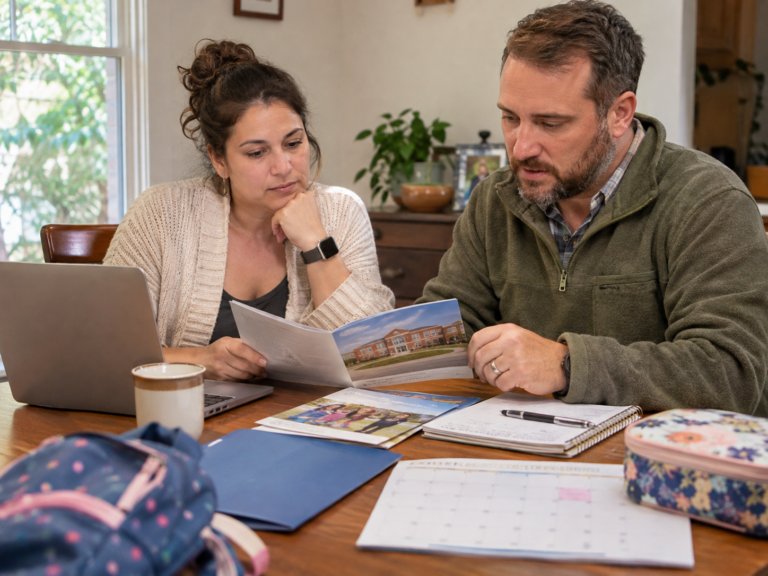
You both want help understanding your child. But one of you pictures practical guidance, while the other hears “another person judging our parenting.” Start by agreeing on the question you need answered.
In Arizona custody mediation, a neutral child specialist may offer focused educational input when their qualifications fit the task. Clarify the role before involving your child. A consultation, therapy, and a court evaluation are different services.
What question should you bring to a child specialist?
For a child-specialist consultation during Arizona custody mediation, bring an observation and a question. “Our child cried before Tuesday’s exchange” describes an event. “Our child doesn’t want to see you” adds an interpretation you haven’t established.
Try a narrower request: “Help us understand which parts of these two transition routines deserve attention.” That gives the professional something concrete to consider without asking them to judge your whole family.
Write down what happened, when it happened, and what each household already tried. Keep your child’s words separate from your own explanation. You don’t need a persuasive case against your co-parent.
Then ask what information is missing. Could an existing teacher answer a factual question with appropriate permission? Do you need education, clinical assessment, or help interpreting an order? Different questions may need different people.
Check the role before the job title
Before hiring a child specialist for Arizona mediation, ask for the exact scope in writing. The title alone doesn’t tell you what the person will do. Their qualifications and engagement terms need to fit the work.
An Arizona court can order an investigation and report about parenting arrangements. A private educational consultation is a different arrangement. Don’t assume hiring a specialist gives that person a court-appointed role.[1]
Use this matrix to prepare your questions. The actual engagement or appointment still controls.
| Professional | Question to ask | Boundary to clarify |
|---|---|---|
| Mediator | How will you guide our discussion? | Facilitation versus clinical care |
| Child specialist | What specific input will you provide? | Qualifications, task, and deliverable |
| Treating therapist | Who is the client? | Treatment versus evaluation |
| Custody evaluator | Who authorized the evaluation? | Appointment and reporting terms |
| Parenting coordinator | What does the court order authorize? | Separate court-appointed role |
Arizona’s current parent information form makes the parenting-coordinator distinction especially clear: that process is not confidential and involves court reports.[2] Don’t carry assumptions from one professional role into another.
And ask about role changes. If your child’s treating therapist is proposed for a different task, have the professional explain the boundaries before you proceed.
What needs to be settled before your child is involved?
Before a child specialist meets your child in connection with Arizona custody mediation, clarify consent, participants, and the information requested. An agreement to mediate doesn’t answer every consent question for a separate professional service.
Arizona’s minor mental-health consent law has exceptions for other law, court orders, and qualifying emergencies. If the proposed work involves screening or treatment, have the provider and your attorney clarify the applicable requirements.[3]
Ask for a written outline covering:
- The question being addressed and the limits of the work.
- Who the professional considers the client.
- Whether your child will participate and why.
- Which records are requested and what permissions are needed.
- What feedback will be provided, to whom, and how.
- How you can ask questions or correct factual errors.
You can ask about alternatives to direct child involvement. Your child shouldn’t have to choose between parents or carry the responsibility for resolving the disagreement.
What will the consultation actually cost?
For a private child-specialist consultation in Arizona, compare the whole task before comparing hourly rates. Meetings may be only part of the bill. Ask about preparation, written reports, cancellation charges, and additional work.
Here’s a hypothetical estimate: two hours of meetings plus one hour of preparation at $180 per hour. Three hours costs $540. An agreed equal division would be $270 each. A separately billed report would increase the total.
Those are illustrative figures, not Aurit’s fees. The useful question is what the estimate includes. A lower hourly rate won’t tell you whether one proposal includes a report and the other doesn’t.
Ask what happens if the work expands. Can the professional estimate the added time before proceeding? Record the answer so an unexpected invoice doesn’t become your next disagreement.
How will you use the information in mediation?
Bring a child specialist’s input back to your Arizona custody mediation as specific questions and possible next steps. Separate what the professional observed from what a parent reported. Keep any uncertainty visible.
Imagine the concern is a difficult school-morning transition. The discussion might become much more practical: where does the backpack stay, who checks tomorrow’s schedule, and what handoff instructions are missing?
You can organize the feedback into three columns: what you learned, what remains unclear, and what you want to discuss. Ask for clarification if you can’t tell how a conclusion was reached.
Keep your child’s needs at the center of that discussion. A sentence that helps you coordinate tomorrow morning may be more useful than another round of arguments about who caused yesterday’s problem.
Keep clinical and safety questions with the right professional
During Arizona custody mediation, use your mediator to help discuss parenting arrangements. Bring diagnosis and treatment questions to a qualified clinician. If a child-specialist consultation reveals a possible treatment need, identify the appropriate next professional step.
Bring legal questions about proposed changes to your attorney. Check the existing order before acting on a plan that could conflict with it.
Raise coercion, intimidation, or safety concerns privately through a safe contact method. You can ask whether the proposed consultation is appropriate before sharing records or agreeing to participate. A shared service shouldn’t pressure you into terms you don’t understand.
Questions you may still have
Can the child specialist make recommendations?
Possibly, within their qualifications and agreed scope. Ask whether the recommendations would be educational, clinical, or evaluative; a recommendation isn’t automatically a binding decision or a revised court order.
Will the specialist’s notes go to court?
There isn’t one answer for every role or record. Arizona mediation protections have exceptions, and preexisting evidence doesn’t become protected merely because it’s used in mediation; ask your attorney about the particular notes, reporting duties, and disclosure rules.[4]
Who chooses and pays the specialist?
For a voluntary joint consultation, address selection and payment in the engagement terms, subject to existing orders. Court-ordered investigations have a separate rule: Arizona allocates those costs based on both parties’ financial circumstances.[1]
Is one specialist fair to both parents?
A shared specialist doesn’t guarantee that both parents will agree with every conclusion. Ask about previous relationships, potential conflicts, and how each parent can provide relevant information without turning the professional into either parent’s advocate.
Bring one clear question
You don’t need to settle every parenting issue before asking for help. Start with the question you want answered and the kind of support that could move the conversation forward.
The Aurit Center helps Arizona parents discuss child-focused parenting arrangements. You can ask how appropriate professional input might fit your circumstances.
Schedule a free consultation to discuss your parenting questions.
Sources
[1] Arizona Revised Statutes section 25-406, Investigations and reports
https://www.azleg.gov/ars/25/00406.htm
[2] Arizona Supreme Court Administrative Order 2025-85, corrected Form 11 information for parents about parenting coordinators
https://www.azcourts.gov/Portals/0/22/admorder/Orders25/2025-85.pdf?ver=79eIidq3NARBIht4zRodlg%3D%3D
[3] Arizona Revised Statutes section 36-2272, Consent for mental health screening or treatment of minors
https://www.azleg.gov/ars/36/02272.htm
[4] Arizona Revised Statutes section 12-2238, Mediation confidentiality and exceptions
https://www.azleg.gov/ars/12/02238.htm